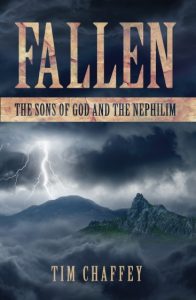
My book on the sons of the God and the Nephilim deals with this topic from more of a systematic theology approach. I believe my position could be made even stronger if I included the points made in this post.
So far in this series I have been making the case that biblical creationists can strengthen their defense of their positions by using biblical theology. Typically, we primarily build and defend our positions through systematic theology, and there is nothing inherently wrong with this approach. However, by neglecting an approach based on biblical theology, we miss out on some of the best arguments for our position, and we run the risk of misinterpreting Scripture. For a more detailed explanation of what I mean along with several examples where we could be making stronger arguments, be sure to check out the first five articles in this series:
- Part One defines biblical and systematic theology and shows how we can give a better defense that the days of creation were 24-hours long.
- Part Two uses this approach to resolve the debate over the meaning of “120 years” in Genesis 6:3.
- Part Three is the second half of the previous post.
- Part Four looks at two popular approaches to biblical theology used by conservative Christians and explains which one I believe is most faithful to the text.
- Part Five shows how we can use this approach to understand a passage that many mistakenly believe is about Satan’s fall.
In this article, I will show how this approach can be used to resolve another controversial passage. Just who are the sons of God and the Nephilim mentioned in Genesis 6:1–4. I have written at length on this subject, including Fallen, my 474-page book that has been called the most detailed biblical study on this topic that you could find. In that book, my approach to this issue focused primarily on a systematic approach to the subject. I gathered every bit of information I could find on a given topic first from an exhaustive study of Scripture and then looking at any other relevant sources. Let’s see how viewing this passage through the lenses of the wilderness-wandering Israelites can lend clarity to this topic and provide a stronger defense of the position I defended my book.
Who Were the Nephilim?
When addressing this question, many people turn to Genesis 6:4 because this is the first verse that mentions the Nephilim, but that does not mean it was the first time that Moses’ audience encountered it. This is part of one of the most controversial passages in Scripture, and the debate instantly focuses on who the sons of God were and whether they are relevant to discovering the identity of the Nephilim. But if we are going to look at this through the lenses of the post-Sinai Israelites, then we should turn to Numbers 13 first because it provides us with information on what the Israelites believed about the identity of the Nephilim.
The 12 spies returned from scouting the promised land and reported that it was truly a land flowing with milk and honey (Numbers 13:27), but the people were strong, and the spies saw the descendants of Anak there (v. 28). Then Caleb told the people that they should go take the land. That’s when ten of the spies brought “a bad report” and stated that it was “a land that devours its inhabitants, and all the people that we saw in it are of great height. And there we saw the Nephilim (the sons of Anak, who come from the Nephilim, and we seemed to ourselves like grasshoppers, and so we seemed to them” (Numbers 13:32–33).
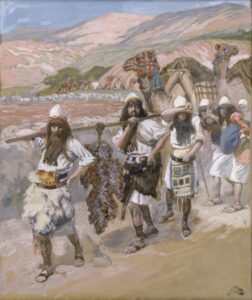 Many people commenting on this passage will say that we cannot really be sure that the Nephilim were there because these spies were giving a “bad report.” However, the term translated as bad report does not mean that the spies were giving false information. The Brown-Driver-Briggs lexicon states that the term (dibbah) refers to an “evil report, specific[ally] a (true) report of evil doing” and it includes Numbers 13:32 as one of the examples. The problem with the spies’ report is not that they were lying, although they almost certainly exaggerated the height of the people by comparing themselves to grasshoppers. Their sin was their faithless response to what they saw and their attempt to frighten Israel into abandoning the conquest.
In fact, we can be confident that the spies did see Nephilim in the land because the author (Moses) tells us that they saw giants in the land (the Nephilim were giants—the term does not mean “fallen ones” as some have supposed). Numbers 13:22 states that they saw the descendants of Anak (Anakim) in Hebron, and he even names three of them (Ahiman, Sheshai, and Talmai). Who were the Anakim? Well, according to Moses, they were a tall people and considered to be Rephaim (giants). They were compared to other giants, the Emim and Zamzummim (Deuteronomy 2:11, 20). In Deuteronomy 3:11, we are told that the iron bed of Og, the last of the Rephaim and the king of Bashan, was nine cubits long and four cubits wide (~13.5 feet by 6 feet).
One other detail to keep in mind is that this bad report was given approximately one year after the Israelites left Egypt. If Moses wrote Genesis sometime during the wilderness wandering, as seems likely, the Israelites may not yet have received Genesis when the spies entered the land. So when an Israelite in the wilderness heard Genesis 6:1–4 for the first time, he was not hearing a bunch of strange terms for the first time. He was hearing about the origin of these large people who inhabit the promised land. Now when we turn to Genesis 6, we should read it with the details in the preceding paragraphs in our minds.
This significantly influences our understanding of Genesis 6:1–4. First, Moses stated that “the Nephilim were on the earth in those days and also afterward.” From the perspective of the original audience, who knew that the Nephilim were on the earth in their day, the natural way for them to understand the first part of verse 4 would be that the Nephilim (giants) were on the earth before the flood and also after the flood.
Second, this verse goes on to state that the Nephilim were on the earth “whenever the sons of God came in to the daughters of men and they bore children to them.” I italicized whenever because most of our English Bibles translate it as when rather than whenever. I have a section in the book dealing with this point, but here’s a brief summary. The combination of asher with the imperfect verb in this past-time context describes iterative or repeated action. Gesenius states that it refers to actions “which were repeated in the past, either at fixed intervals or occasionally.” The problem with translating it as when is that it makes the passage unclear. Who were the Nephilim? Not sure. Maybe they were the offspring of these unions or maybe they were already on earth when these things took place. However, Genesis 6:4 is not ambiguous as to when and how the Nephilim were on the earth “in those days and also afterward”—the iterative force of Genesis 6:4 clarifies that they were there whenever the sons of God and the daughters of men produced offspring. In other words, the Nephilim resulted from these unions.
Third, as we have seen in previous articles in this series, Genesis provided some crucial background information for the Israelites—it’s their backstory. They could know why the Canaanites, Moabites, and Ammonites were illegitimate heirs of the land. They could know why lifespans had been significantly reduced in recent generations. And now the wilderness-wandering Israelites could know the origin of the Nephilim. How did these giants come about? Where did they come from? They were on the earth before the flood, and they were on the earth in the days of Moses because the sons of God and the daughters of men produced offspring both before and after the flood.
Who Were the Sons of God?
Of course, this raises an important question. Who were the sons of God? Can our biblical theology approach help us here? I believe it can, but before we address that, I think we can see significant problems with the views that see the sons of God as being humans, whether men in the line of Seth or nobles. Once the iterative relationship in verse 4 is recognized, the human views face an obvious difficulty: why would ordinary human marriages repeatedly be associated with the appearance of Nephilim? And if the “daughters of men” refers to the line of Cain, as the so-called Sethite view typically states, then how were the Nephilim on the earth after the flood? Cain’s line would’ve ended at the flood.
That leaves us with the fallen angel view, the one that has by far the most biblical support and the most objections. I spent 16 chapters in my book identifying the sons of God and answering every objection I have ever heard to this position, so I will not repeat all of that here. The typical approach would be to show that wherever else the Hebrew bene ’elohim or bene ha ’elohim is used, such as three times in Job, it obviously refers to angelic beings. Then we could show how similar Hebrew terms (bene ’elim) and the Aramaic equivalent (bar ’elahin) also refer to angelic beings. This approach can build a strong case for the angelic view of Genesis 6, but our goal is to see if the wilderness-wandering Israelites could have had some insights to help us identify the sons of God. While I believe Job lived prior to Moses, we cannot assume that the Israelites possessed the book of Job during the wilderness wandering.
The best place to turn is Deuteronomy 32 because it likely included bene ’elohim twice when it was originally written, but for some reason, it is not found in the Masoretic text of that chapter. However, we can look at the older Hebrew texts among the Dead Sea Scrolls and the Greek Septuagint as well as some internal textual details to demonstrate this claim.
First, most English Bibles will mention “the sons of Israel” at the end of verse 8, although they often include a text note explaining that a fragment of this verse was found among the Dead Sea Scrolls that had bene ’elohim (sons of God) instead of sons of Israel. Another fragment was found that had bene ’el___ (the final letters were missing but had the right amount of space for that missing word to be ’elohim. There are other textual reasons why bene ’elohim should be viewed as the original over bene yisrael. The passage is talking about the time when God divided the nations (Babel), and Moses states that God divided the people according to the number of the “sons of ____.” The reading “sons of Israel” is extremely difficult in context. Moses is describing the division of mankind into nations at Babel, centuries before Israel or his sons existed. Attempts to relate the phrase to the seventy members of Jacob’s family who later went down to Egypt require importing a much later event into a passage describing the division of the nations. By contrast, “sons of God” fits naturally with the immediate context, particularly the contrast in the next verse between the nations and Yahweh’s own allotted people, Jacob.
[NOTE: There is an interesting point that can be made here, although this is not part of my biblical theology approach. Genesis 10 names 70 people groups, which many scholars believe are the groups that departed from Babel. An ancient Canaanite text mentions El and his 70 sons (bn ’il). This written in Ugaritic, and like Hebrew, it is a Northwest Semitic language, so they share many similarities.]
Second, verse 43 has multiple textual issues. If you read it in most English Bibles, you will see a total of four lines. A fragment from the Dead Sea Scrolls includes the words “and let all the gods worship him” while the Septuagint has “and let the angels of God worship him.” Speaking of the Septuagint, it has a total of eight lines containing obvious parallelism between some of the lines.
Rejoice, ye heavens, with him,
and let all the angels of God worship him;
rejoice ye Gentiles, with his people,
and let all the sons of God strengthen themselves in him,
for he will avenge the blood of his sons,
and he will render vengeance, and recompense justice to his enemies,
and will reward them that hate him;
and the Lord shall purge the land of his people. (Deuteronomy 32:43, LXX)
Of particular interest for this article is the parallel between “angels of God” and “sons of God” in the second and fourth lines, respectively. The Septuagint usually translated the Hebrew bene ’elohim as “angels of God.” A strong case can be made that the original text of Deuteronomy 32:43 contained the term “sons of God” and that it referred to angelic beings. The New Testament lends support to the Septuagint reading because Hebrews 1:6 quotes from it when it states, “Let all the angels of God worship him.” Again, this wording is absent from the Masoretic, but it is preserved in the Septuagint, while one of the Dead Sea Scrolls preserves the same concept in Hebrew.
Assuming that Deuteronomy 32:8 and 43 originally mentioned the sons of God and that they were angelic beings, would that have any bearing on how the sons of God should be understood in Genesis 6:1–4? Deuteronomy 32 was part of Moses’ farewell address, given shortly before he died. They probably had received Genesis before this moment, so we cannot say for certain that they would have known the details of Deuteronomy 32:8 and 32:43 when they first read or heard Genesis 6. However, look closely at the context of verse 8. Beginning with verse 7, we read the following:
Remember the days of old; consider the years of many generations; ask your father, and he will show you, your elders, and they will tell you. When the Most High gave to the nations their inheritance, when he divided mankind, he fixed the borders of the peoples according to the number of the sons of God. (Deuteronomy 32:7–8)
Moses seems to imply that their fathers were aware of the information in these verses. So it seems that the wilderness-wandering Israelites would have understood “sons of God” to refer to angelic beings. And even if they were not aware of this information, the terms were still being used that way by the end of Moses’ life, so it is hardly a stretch to think that this understanding of bene ‘elohim did not suddenly originate when Moses delivered his farewell address.
Conclusion
To modern readers, Genesis 6:1–4 introduces two mysterious groups with almost no explanation: the “sons of God” and the “Nephilim.” But they do not seem to have been mysterious to Moses’ audience at all. They knew that the Nephilim were on the earth in their day, and they knew that they were giants. And it seems likely that they understood bene ’elohim was a term for angelic beings. Thus, Genesis 6:1–4 is an origins story of the Nephilim. These giants had existed before the flood “and also afterward” because they appeared whenever the sons of God produced offspring with the daughters of men. This information would be useful for the Israelites who would soon face these giants as Joshua led them to take possession of the land God had promised them.
This is yet another example of how biblical theology can strengthen creation apologetics. Rather than starting with Genesis 6 and applying a framework on it derived from our systematic theology or racing off to later biblical authors to see what they may or may not have said on the subject, we should first ask what revelation the original audience of Genesis already possessed and how they could have understood the passage in light of that revelation. Other revelation in Job, Daniel, 1 and 2 Peter, and Jude can then corroborate that interpretation.
I find it interesting that this approach seemed to work better when starting with explaining who the Nephilim were before moving on to identifying the sons of God. Part of the reason for that is that there are clearer details in Moses’ writings about the giants than there is about the sons of God. But in Fallen, when using my systematic approach to these topics, I found it necessary to first identify the sons of God because there is more information elsewhere in Scripture and because once their identity was established it became easier to identify the Nephilim. This is one of the reasons I argue for a both/and approach with biblical and systematic theology. The two approaches can reach the same conclusion by following different but complementary lines of evidence.