King Saul, a Witch, and an Elohim—Part One

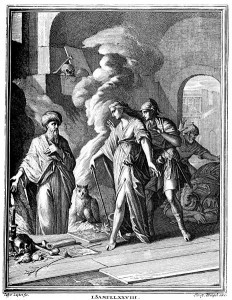
The Spirit of Samuel and King Saul at En Dor by Casper Luiken (1712).

The Spirit of Samuel and King Saul at En Dor by Casper Luiken (1712).

One of the strangest accounts in Scripture appears in 1 Samuel 28. On the night before his death, Israel’s first king, Saul, made an infamous visit to a medium in hopes of contacting the deceased prophet Samuel. What happened during their encounter has been the source of some contention among interpreters.

King Saul fought many battles, and it was customary for him to seek the Lord’s favor prior to a conflict. This is not to say that he was a faithful king, but he had previously wanted to hear from God before going to war (1 Samuel 13:12 and 15:1). And now that Samuel had passed away, Saul was quite fearful about what the following day’s battle against the Philistines would bring.

The mediums and spiritists had already been kicked out of the land (1 Samuel 28:3), but Saul still wanted to hear what Samuel had to say. So Saul and some of his men went to En Dor to ask a medium to contact Samuel for him—an action strictly forbidden in Deuteronomy 18:10–12. What happened next has been debated for centuries.

A “spirit” (1 Samuel 28:13) appeared and told Saul that he would die the next day. But was it really Samuel who appeared or was it an evil spirit impersonating Samuel?

A Satanic Impostor?

Matthew Henry’s comments represent the beliefs of many Christians on this issue. He confidently stated that Satan came “in disguise, in the disguise of Samuel’s mantle”1

For Henry, this is an open-and-shut case. He wrote, “That it could not be the soul of Samuel himself they might easily apprehend when it ascended out of the earth, for the spirit of a man, much more of a good man, goes upward, Eccl. 3:21.”2 And since Satan is said to be able to transform himself into an angel of light (2 Corinthians 11:14), Henry believed that it is quite obvious that Satan was given permission to appear to Saul.

John Gill wrote in no uncertain terms that “this was a diabolical spectre, or apparition, or the devil, that appeared in the form and shape of Samuel, and mimicked him.”3 Gill’s main argument against the apparition being Samuel himself is that the Lord’s prophet would not have been at the beck and call of a witch.

This opinion is also shared in the Pulpit Commentary, and it has been quite popular among Christians in general. But does it really handle the text properly?

An Appearance of Samuel

As with any debated passage, it is important to carefully consider what the text actually states. In this strange encounter, we are told by the writer in very plain language that it was Samuel who appeared to Saul. Consider each of the following verses, and notice that they are not spoken by Saul or the medium, but are part of the narration. In other words, it is the author of 1 Samuel 28 who is telling us that Samuel appeared.

“When the woman saw Samuel, she cried out with a loud voice.” (v. 12)

“And Saul perceived that it was Samuel, and he stooped with his face to the ground and bowed down.” (v. 14)

“Now Samuel said to Saul, ‘Why have you disturbed me by bringing me up?’” (v. 15)

“Then Samuel said: ‘So why do you ask me, seeing the Lord has departed from you and has become your enemy?’” (v. 16)

“Immediately Saul fell full length on the ground, and was dreadfully afraid because of the words of Samuel.” (v. 20)

Five times the narrator tells us that it was Samuel. The author gives no indication in the text that this is not really Samuel. It does not say, “Now the spirit impersonating Samuel said to Saul…” or anything of the sort. The text simply tells us that Samuel appeared and delivered a message to Saul.

Accurate Prophecy

Indeed, the straightforward meaning of the text is that it actually was Samuel who appeared to Saul. While this alone makes a strong case for the position, it is not the only evidence. What Saul was told by the “spirit” also came to pass.

Because you did not obey the voice of the Lord nor execute His fierce wrath upon Amalek, therefore the Lord has done this thing to you this day. Moreover the Lord will also deliver Israel with you into the hand of the Philistines. And tomorrow you and your sons will be with me. The Lord will also deliver the army of Israel into the hand of the Philistines. (1 Samuel 28:18–19)

On the following day, Saul and his sons were slain by the Philistines (1 Samuel 31:6), just as Samuel had foretold. The Israelite army was also defeated, as prophesied by the apparition (1 Samuel 31:1, 7).
My Th.M. thesis on the sons of God and the Nephilim addresses the meaning of 'elohim at length. It is available in print or for Kindle.

My Th.M. thesis on the sons of God and the Nephilim addresses the meaning of ‘elohim at length. It is available in print or for Kindle.

If this were an evil impostor who appeared, then we would need to conclude that this entity told the truth and accurately foretold the future. Granted, it was the very near future, and many could have guessed the outcome of the battle. Even Saul feared for his life, which is why he sought out the medium in the first place (1 Samuel 28:5). Nevertheless, Jesus said that Satan is the father of lies who “does not stand in the truth, because there is no truth in him” (John 8:44). Why should we think that in this passage Satan shows up and speaks the truth?

Taking the text at face value makes far more sense, and this would mean that Samuel appeared to Saul. This type of action is almost certainly not a normal ability for a deceased human, so it seems as if God made an exception here and sent His prophet to deliver a message of judgment to the wayward king of Israel.

Conclusion to Part 1

I’m only halfway through the investigation of this passage. In the next post on this subject, I’ll cover some other passages that shed some light on the correct interpretation of this strange encounter. Also, this account provides an opportunity to clear up an important misunderstanding many Christians have about the Hebrew word ’elohim. Here’s a hint: that’s the word translated as “spirit” in this passage.

Thanks for reading!

  1. Matthew Henry, Matthew Henry’s Commentary on the Whole Bible: Complete and Unabridged in One Volume (Peabody: Hendrickson, 1994), 432. [↩]
  2. Ibid. Italics in original. [↩]
  3. John Gill, Commentary of the Whole Bible, 1 Samuel 28:14. [↩]

The Lost Gospel that Isn’t

The Lost Gospel by Jacobovici and Wilson puts a modern spin on an ancient tale.

The Lost Gospel by Jacobovici and Wilson puts a modern spin on an ancient tale.

Here we go again. Simcha Jacobovici’s new book, The Lost Gospel: Decoding the Sacred Text that Reveals Jesus’ Marriage to Mary Magdalene, is due out tomorrow (11/12/14). Based on the subtitle, it’s hard to imagine that the book won’t be stuffed full of distortions and outright lies.

Jacobovici is probably best known for his book, The Jesus Family Tomb, and corresponding film titled The Lost Tomb of Jesus. These works have been thoroughly discredited by conservative, liberal, and skeptical scholars alike. His conclusions were often built on falsehoods. I dedicated one chapter to refuting his claims in my book on the Resurrection (In Defense of Easter). But in a world where The da Vinci Code, with all of its revisionist history, sexism, conspiracy theories, and blasphemous slander of Jesus Christ and His church, can sell over 80 million copies, Jacobovici’s latest tome will undoubtedly find fertile soil to take root.

Although he makes many claims about archaeology and ancient texts, Jacobovici has no formal training in either field. He did earn an M.A. in International Relations and has made some successful documentaries.

Since the book will not be released until tomorrow, I have not been able to read it in its entirety so a full critique will not be made here. However, I have looked through the preview available on Amazon, and what I have read so far warrants plenty of skepticism toward the premise of the book. [Update: My full review of this book is now available online at Answers in Genesis.]

What Is this “Lost Gospel”?

The focus of The Lost Gospel is an ancient book called The Story of Joseph the Just and Aseneth his Wife.1 Scholarly consensus has not been found concerning the book’s origin. The dating of the book has been placed anywhere from the first century BC to the sixth century AD. It is generally believed to be a Jewish work, but some scholars, like Richard Bauckham, believe it was written by a Christian.

Joseph and Aseneth reads much like other apocryphal books penned during or soon after the Second Temple period. If taken in a straightforward manner, the book provides a fictitious backstory to the life of Joseph’s wife Asenath, the daughter of Poti-Pherah mentioned in Genesis 41:50. Numerous spellings exist for her name depending upon the language of the manuscript used for translation. I will use the NKJV spelling, Asenath, unless I am referring to the title of the book, which spells her name as Aseneth.

According to the ancient tale, Asenath was the most beautiful woman in the land. This young virgin despised all of the suitors who sought her hand in marriage. Kept in a tower for much of her life and attended by seven maidens who shared her birth date, Asenath spent her time worshiping her false gods. Her parents arrived and told her she was to become Joseph’s wife. Asenath angrily refused such a proposition and returned to her chamber. Looking out the window, she saw Joseph and was instantly lovestruck. Upon being introduced to him by her father, Asenath attempted to kiss Joseph, but he rebuffed her since he used his mouth to bless God, and she used her lips to bless dead and dumb idols. Joseph took pity on her and prayed for her. She returned to her room, threw out all of her idols, fasted, mourned, and sat in ashes for seven days. On the eighth day, she was visited by an angel who told her that God had purified her and that she would become Joseph’s wife.

Joseph marries Asenath and they have two children, Ephraim and Manasseh. Then Pharaoh’s son, who had earlier sought to marry Asenath, plotted to kill Joseph and take her to be his wife. Scheming with some of Joseph’s brothers, Pharaoh’s son sought to kill his own father, but after being turned away by the guards, he was wounded by Benjamin, and eventually succumbed to his wound.

The story is kind of a fun read, and it provides some insight into how Joseph and his wife were viewed two millennia ago. The writer clearly knew the Old Testament and included some interesting details drawn from Genesis, Judges, and 1 Samuel. For example, Benjamin hurled a large round stone drawn from a brook and struck Pharaoh’s son on the left side of his forehead. This sounds like a mix between David and Goliath and the 700 left-handed Benjamites described in Judges 20:16 who were deadly stone slingers.

Is This Really a Lost Gospel?

But what does all of this have to do with a lost gospel? Nothing. Nothing at all! The Story of Joseph the Just and Aseneth his Wife is neither lost nor is it a Gospel. Professor Mark Goodacre has maintained an Aseneth web site since 1999. You can read the story for yourself on his site.

The subtitle explains the Jacobovici’s and Wilson’s goal. They have sought to “decode” Joseph and Aseneth so they can show the world that this ancient book was really about Jesus and Mary Magdalene being married and having two sons. It seems that the book will offer up the same tired lies that the male-dominated church of the first few centuries despised Mary Magdalene and attempted to bury the “truth” about her relationship with Jesus.

My book, In Defense of Easter: Answering Critical Challenges to the Resurrection of Jesus, examines the so-called Jesus Family Tomb. Available at www.midwestapologetics.org/shop.

My book, In Defense of Easter: Answering Critical Challenges to the Resurrection of Jesus, examines the so-called Jesus Family Tomb. Available at the Midwest Apologetics store.

Heard this before? Of course you have. It’s the same story found in dozens of books from the past few decades, including The da Vinci Code and Jacobovici’s Jesus Family Tomb. Jacobovici has simply found another ancient document to distort and spring upon a largely biblically illiterate culture that loves conspiracy theories, particularly those that impugn Christ or His church.

Jesus was never married to Mary Magdalene or anyone else. This assertion has been made frequently, but all alleged support for such a notion crumbles. Two years ago, Dr. Karen L. King, a legitimate scholar, promoted the idea that she had been handed a fourth century fragment where Jesus mentioned His wife. The credit-card sized fragment is almost certainly a fake, and even if it were legitimate, it was written centuries after the biblical Gospels which were written by eyewitnesses or men who interviewed eyewitnesses. I have elsewhere published a response to Dr. King’s claims that provides five reasons we can be confident Jesus was not married.

Mary Magdalene was certainly a faithful follower of Christ, and she enjoys the unique privilege of being the first person to see the risen Savior, but this in no way makes her His wife. There was never any early church conspiracy to blot out her memory or anything of that nature.

Finally, even the Christian scholars who believe the Joseph and Aseneth may be an allegory about Jesus do not agree with Jacobovici. They do not believe it is about Mary Magdalene. Rather, they suspect that it may be an allegory about Jesus and His church.

Based on my own reading, the ancient writing seems to be just another interesting piece of fiction about biblical characters. These stories were fairly popular in New Testament times, sort of like historical fiction novels today. I’m willing to be corrected on this, but it has the hallmarks of these tales of Old Testament heroes.

Conclusion

Simcha Jacobovici seems like the type of guy who could charm your socks off. By all accounts I’ve read he is very friendly and likeable. However, these traits make his lies even more dangerous. This man has repeatedly spread lies about the Son of God. He has shown that he is more than willing to distort the facts. He has creatively cut interviews so that those who disagree with him are made to look like they support his conjectures. Sadly, his lies will be taken as gospel truth by people eagerly looking for ideas about Jesus that contradict Scripture.

Christians have no need to worry about his claptrap. The biblical Gospels of Matthew, Mark, Luke, and John have given us the truth about Jesus and His life. They explain that He was born of a virgin, lived a sinless life, died a sacrificial death on the Cross, and victoriously conquered the grave three days later.

I pray that rather than repeatedly slandering Jesus, Jacobovici would repent of his sins and call upon the loving and gracious Savior who gave His life so that even the vilest of sinners could be saved.

  1. Simcha Jacobovici and Barrie Wilson, The Lost Gospel: Decoding the Sacred Text that Reveals Jesus’ Marriage to Mary Magdalene (New York, NY: Pegasus Books LLC, 2014), p. 4. [↩]