
Is it sinful to celebrate the birth of Christ on December 25? A growing number of professing Christians are claiming it is, but their arguments are extremely poor.
It’s that time of year again. Many Americans will be stressed due to a frenzied schedule of shopping, ugly-sweater contests, Christmas parties, baking, and family gatherings. Meanwhile, a small, but growing and increasingly vocal group of people are making their own mark on the holiday season. I call them the Anti-Christmas Cult. Oh, they also come out at Easter time.
To be fair, I don’t really believe these people have formed a cult, but this description does not seem too far from the mark when you witness the way many of them behave when the words “Christmas” or “Easter” are used. If you are not really familiar with this group, you won’t have to look hard to find them. Actually, they will make an effort to find you to tell you how pagan and evil it is to celebrate Christmas and Easter.
I work for a ministry that uses this time of year to share the good news that the Son of God became one of us so that through His sacrificial death, burial, and Resurrection, we could be saved from our sins. Every year in December we post articles that help clear up some of the misconceptions that people have about the birth of Christ as described in Matthew and Luke. We do not tell anyone that they must celebrate Christmas, but encourage those who decide to celebrate the holiday to focus on Christ rather than all the extra-biblical traditions. And every year dozens, if not hundreds of people jump all over our Facebook posts to tell everyone how pagan Christmas is and how sinful it is for people to celebrate the birth of Christ at this time of year.
Many of the attacks come from people involved in what has been called the Hebrew Roots Movement. These are not Jewish people, but professing Christians who have been caught up in the idea that Christians are supposed to follow selected portions of the Mosaic Law. It’s one thing to seek to understand Old Testament teachings to gain a deeper understanding of Scripture, but these people go far beyond that. Just as the heretical Judaizers of the 1st century added works of the Law to the gospel message (making it a false “gospel”), the Hebrew Roots Movement has added arbitrarily selected elements of the Law to the Christian message.
There are some really sad elements to this movement. First and foremost, many of the folks are in danger of denying the gospel because they behave as if a person can only be saved if he follows the Law of Moses—well, at least the portions of it that they highlight (primarily the Levitical feasts and dietary laws). A brief study of Galatians should disavow them of such legalizing practices, but sadly they ignore Paul’s plain instruction in this book (see especially Galatians 5:18 and James 2:10). Second, I believe they unwittingly disparage the Jewish people through their actions—they mispronounce and misspell Hebrew names while acting as if they are true Jews. Third, they use a vast array of fallacious arguments based on careless research and misinterpretations of Scripture.
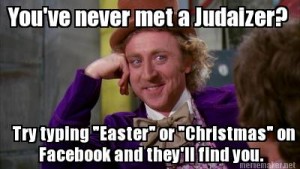
Neo-Judaizers are quite vocal in their opposition to Christmas and Easter.
One of the major claims of this group is that the Bible forbids the use of Christmas trees in Jeremiah 10. This notion is an absurd interpretation of a passage that speaks against the carving and decoration of wooden idols to be worshipped. I have never heard of a Christian worshipping a tree, and I have never put up a tree in my house, but that has not stopped these folks from accusing me of violating the supposed prohibition against Christmas trees in Jeremiah 10. [Update on 11/27/16: My wife found an artificial tree for $5 last year and has put that up. When I wrote the article two years ago, I had not put up a tree.]
I have written elsewhere to deal with many of the false claims and faulty arguments of this movement so I won’t elaborate on them here (see links at end of post for more details). I want to close this post by sharing a piece of satire I worked on with a friend a few years back. This is not directed at those who simply choose to not celebrate Christmas at this time of year; Christians have every right to not celebrate Christmas since we are not commanded to do it. But Christians also have the right to celebrate the birth of Christ on December 25 or on any other day of the year. This satirical article is directed at those who obnoxiously attack Christians with Jeremiah 10 whenever they hear the word “Christmas” uttered or see it posted in social media.
Seven Ways to Avoid Worshipping Your Christmas Tree
(A satirical critique of a fallacious argument against Christmas trees by Chuck and Tim)
Thus saith the LORD, learn not the way of the heathen, and be not dismayed at the signs of heaven; for the heathen are dismayed at them.
For the customs of the people are vain: for one cutteth a tree out of the forest, the work of the hands of the workman, with the axe. They deck it with silver and with gold; they fasten it with nails and with hammers, that it move not.
They are upright as the palm tree, but speak not: they must needs be borne, because they cannot go. Be not afraid of them; for they cannot do evil, neither also is it in them to do good. (Jeremiah 10:2–5, KJV)
Right here in Scripture we see a clear condemnation of the abominable practice of decorating Christmas trees. Yet God is merciful. Repent, and you will be forgiven for your past transgressions.
However, the appeal to decorate a Christmas tree may be a strong one. In many cases, this pagan ritual has become so deeply entrenched in our family traditions that it can be hard to give up.
With that in mind, and with Scripture as our guide, here are seven principles you can use to continue decorating your tree, while preventing yourself from inadvertently worshipping it.
1. Know where your tree comes from.
The Bible specifically warned about one who “cutteth a tree out of the forest.” Therefore, you must obtain your tree elsewhere.
You certainly can’t risk buying one from a store. Who knows where those came from?
It’s probably best to just find a tree growing by the side of the road—far from a forest—and cut it down.
2. Cut it down the correct way.
The Bible also talks about pagans cutting down their trees “with the axe.” We must eschew this detestable instrument of demolition.
Stick with safer tools like chainsaws or laser beams.
Alternatively, you may avoid both of the pitfalls above by simply buying a fake tree.
3. Get a tree that talks and/or moves.
There is yet another advantage to purchasing a fake tree. Some of them come with a built-in speaker, allowing them to “sing” or “talk.” This would counteract the warning that trees “speak not.”
Other fake trees are mounted on a base that rotates, thus invalidating the warnings about their being unable to “move” or “go.”

Is this really what Jeremiah 10 speaks against? Only if the Christmas tree is an idol that you worship.
4. Be careful how you mount it.
This is one of the more important warnings. When the pagans get a Christmas tree, “they fasten it with nails and with hammers.” We must not do likewise.
Instead of hammers and nails, try using duct tape, glue sticks, or zip ties.
5. Mount it in the correct position.
The tools you use to mount your tree aren’t the only things that matter. The position of the mounted tree is also vitally important.
The Bible warns about trees that are as “upright as the palm tree.” Therefore, your tree should at the very least be mounted at a distinct angle.
But just to be safe, we’d advise mounting it completely sideways from a wall.
6. Decorate it properly.
This is probably the most obvious piece of advice, but it is extremely important. Whatever you do, do not place any gold or silver decorations on your tree!
All other colors should be fine, but there had better not be a scrap of silver tinsel on there!
7. Place presents carefully.
One final obstacle will stand in your way. When placing a present under the tree, you run the risk of accidentally bowing to it. This would be an unacceptable act of pagan worship!
Your best bet is to order presents online. Then, when delivery men show up, have them place the packages directly under the tree themselves. Thus, they will act as scapegoats, averting any wrath away from your own household.
However, you may at times have to place the packages yourself. If that is the case, I would advise holding the present behind you going backward to the tree with it, similar to how Shem and Japheth covered their father, Noah (Genesis 9:23, KJV).
We said we have seven principles for you, but we actually have one more: Learn to interpret your Bible in context.
Whether you choose to celebrate the birth of Christ on December 25 or choose not to celebrate it, serve the Lord wholeheartedly in whatever you are doing that day and every other day of the year.
Here are links to my responses to some of the other arguments against celebrating Christmas:
Common Misconceptions about Christmas
More Christmas Misconceptions—Part One
More Christmas Misconceptions—Part Two
Christmas Misconceptions: Legalism or License
Merry Christmas!
Thanks for reading!