
Did Paul Only Want to Preach Christ Crucified?

Teaching on the Resurrection at the Creation Museum.

One of the many opportunities I have had to teach on the Resurrection

In response to hearing a message on the importance of the Resurrection that I’ve given a few times in the past two months I have had a couple of people disagree with my claims. It isn’t that they don’t believe that the Resurrection is vitally important, but they both cited a verse that supposedly contradicts my statement about the centrality of the Resurrection in the sermons delivered by the apostles that are recorded in the New Testament. As we’ll see, my friends who have challenged me on this have overlooked a few key points, and they have misunderstood the verse they cited.

My previous blog post explained my position on the centrality of the Resurrection to apostolic preaching. It also includes an embedded video to a 25-minute presentation I gave on the subject. So how could one possibly object to my message which simply surveyed each of the sermons in the book of Acts and then Paul’s letter to the Romans to demonstrate how frequently the Resurrection was the focal point?

The objection made by my two friends is that Paul said in 1 Corinthians that he only wanted to preach Christ crucified. In making this claim, they apparently think that Paul was only talking about the Cross, and not the Resurrection. But this simply is not the case.

First, we are told in Acts 18 what Paul did when he went to Corinth. In Acts 18:4 we read that Paul “reasoned in the synagogue every Sabbath, and persuaded both Jews and Greeks.” While this verse doesn’t specifically tell us what Paul said in the synagogue, we can be quite confident about the content of his message because the previous chapter tells us what Paul’s customary approach was in the synagogues he entered in the various cities. Acts 17:2–3 state, “Then Paul, as his custom was, went in to them, and for three Sabbaths reasoned with them from the Scriptures, explaining and demonstrating that the Christ had to suffer and rise again from the dead, and saying, ‘This Jesus whom I preach to you is the Christ.'”
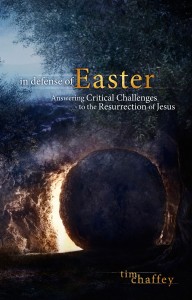
My new book on the Resurrection of Jesus includes a chapter about the disturbing trend of neglecting the Resurrection when sharing the gospel. See www.midwestapologetics.org/shop for more details.

My new book on the Resurrection of Jesus includes a chapter about the disturbing trend of neglecting the Resurrection when sharing the gospel. See www.midwestapologetics.org/shop for more details.

So what did Paul do when he went into the synagogues? He reasoned with the people, “explaining and demonstrating that the Christ had to suffer and rise again from the dead.” What did he preach in the Corinthian synagogue? Undoubtedly, his message was that Christ had to suffer and rise from the dead. But we don’t need to rely on my deductions based on these passages, we have Paul’s very own words to the Corinthians!

In 1 Corinthians 15:1–4 Paul tells us exactly what message he preached to the Corinthians.

Moreover, brethren, I declare to you the gospel which I preached to you, which also you received and in which you stand, by which also you are saved, if you hold fast that word which I preached to you—unless you believed in vain. For I delivered to you first of all that which I also received: that Christ died for our sins according to the Scriptures, and that He was buried, and that He rose again the third day according to the Scriptures… (emphasis added)

Paul specifically tells us that he preached the gospel message of Christ’s sacrificial death, burial, and Resurrection to the Corinthians. But didn’t he say that he only wanted to preach Christ crucified? Not exactly. Let’s quickly take a look at this verse that my friends have cited.

In 1 Corinthians 2:2, Paul wrote, “For I determined not to know anything among you except Jesus Christ and Him crucified.” A couple of brief comments are in order. First, Paul did not say that he only wanted to preach Christ crucified. He stated that he determined to preach Jesus Christ and Him crucified. It wasn’t only the Crucifixion that he preached; it was Jesus Christ and the Crucifixion. This would undoubtedly include the Resurrection (as we know it did based on his statement in 1 Corinthians 15).

Second, as with every other passage, it is very important to look at the context. In the surrounding verses, Paul explains that he didn’t try to wow the Corinthians with excellence of speech or human wisdom. Instead, his focus was on proclaiming the gospel message (sacrificial death, burial, and Resurrection of Jesus Christ), and to do this, he reasoned in the synagogue that Jesus is the Christ and that He had to suffer and rise again.

Paul also wrote in 1 Corinthians 1:23 that “we preach Christ crucified, to the Jews a stumbling block and to the Greeks foolishness…” Someone may think this is an indication that Paul only focused on the Crucifixion, but this simply is not the case. Paul is likely using a figure of speech known as synecdoche, where a part of something is used for the whole. In this case, “Christ crucified” is shorthand for “the sacrificial death, burial, and Resurrection of Jesus Christ.” I believe many Christians do the same thing today—they speak of Christ’s death on the Cross and neglect to mention the Resurrection, it isn’t because they don’t believe in the Resurrection, but it’s because in their mind, the Resurrection is a given. In a sense, by naming one (Crucifixion), they mean the whole message (death, burial, and Resurrection).

Did Paul do the same thing? I am very confident that this is exactly what he meant. After all, the death of Jesus was not foolishness to the Greeks. They didn’t have a problem with someone dying. What was foolishness to the Greek mind was the Resurrection. We see that the same thing happened in Acts 17:18 and Acts 17:31–32 when Paul was in Athens. As soon as he mentioned the Resurrection, the Greeks thought he was foolish. This is why he spent 58 verses in 1 Corinthians 15 establishing the importance of the physical Resurrection of Jesus and the future physical resurrection that awaits us. The Greeks really struggled with the concept of a physical resurrection since to them, the spiritual world was good and pure while the physical world was corrupted and evil. Why would someone even want to believe in an eternity involving physical bodies?

Acts 18 tells us that Paul spent 18 months in Corinth. Surely, he taught them all sorts of biblical doctrine (we know he told the Ephesian elders in Acts 20:27 that he had not failed to declare to them the whole counsel of God). Why would we think that he only spoke to them of the Crucifixion?

Paul, like Peter and the other apostles, always emphasized the Resurrection (as well as the Crucifixion) in his proclamation of the gospel. By neglecting this important truth, many well-meaning Christians have delivered an incomplete gospel message by focusing solely on the Cross. Notice, I did not say they delivered a false gospel, but their message is incomplete because they do not mention the Resurrection. As I’ve said before, the fact that Jesus died on the Cross for our sins is good news indeed, but the message does not become the good news until He conquers the grave.

A Hopeless Gospel

My new book on the Resurrection of Jesus includes a chapter about the disturbing trend of neglecting the Resurrection when sharing the gospel. See www.midwestapologetics.org/shop for more details.

My new book on the Resurrection of Jesus includes a chapter about the disturbing trend of neglecting the Resurrection when sharing the gospel.

Before anyone attacks me as a heretic for the title of this article I need to state that the gospel is full of hope. The gospel “is the power of God to salvation for everyone who believes, for the Jew first and also for the Greek” (Romans 1:16). Since people are saved by God through the gospel message, how could I possibly put the words hopeless and gospel together?

Listen closely the next time you hear someone explain the gospel. There’s a strong possibility that what you hear will go something like this:

We have all sinned against a holy God. As a result of our rebellion, we deserve His wrath and judgment. But the good news is that God sent His Son, Jesus Christ, to bear our sins upon Himself on the Cross. His sacrificial death satisfied God’s wrath against sin, and all who will turn from their sins and place their faith in Jesus alone will be saved.

I cannot tell you how many times I have heard pastors and other Christian leaders say something just like this while presenting the gospel. The problem is, although the message above is true, it is incomplete. There is a gaping hole in this message.

The Gospel in a Nutshell?

Before I explain what that gaping hole is, look at the following quote from popular pastor Tim Keller and see if you can figure out what is missing.

Christianity is a way that says if you come to Jesus Christ, even if you aren’t good and decent, even if you aren’t wonderful, and even if you don’t have a good record, anybody through Christ can find God. Somebody says, ‘How can that be?’ Let me just put the gospel in a nutshell: because Jesus Christ lived a perfect life and died a perfect death, now God treats you, when you believe in Christ, as if you have done everything Jesus has done and you have suffered everything Jesus has suffered. God treats believing sinners as if they had done everything Jesus has done and suffered everything Jesus has suffered.

That means when you believe in Christ you’re adopted not on the basis of your record, but on his record. You’re adopted into the family and treated as if you’d accomplished everything he’s accomplished. That’s the gospel. Somebody says, ‘It’s too easy.’ I don’t know how many times people have said, ‘That’s just too easy. You mean you just receive it?’ Yeah, but you have to receive it through repentance, and that’s what’s not easy at all. The only way to get to that peace is through paying the pain of repentance. In other words, all you need is nothing, but most people don’t have that.1

Ironically, this so-called “gospel in a nutshell” is not an accurate representation of the gospel preached in the New Testament, but it does match what many modern Christians claim is the gospel. Have you figured out what’s missing yet?

The Actual Gospel

In 1 Corinthians 15, Paul clearly spelled out the gospel message he preached. Compare his words with the examples cited above.

Moreover, brethren, I declare to you the gospel which I preached to you, which also you received and in which you stand, by which also you are saved, if you hold fast that word which I preached to you—unless you believed in vain.
For I delivered to you first of all that which I also received: that Christ died for our sins according to the Scriptures, and that He was buried, and that He rose again the third day according to the Scriptures… (1 Corinthians 15:1–4, NKJV)

Paul stated that the gospel message he preached, the gospel message that saves, is that Jesus “died for our sins according to the Scriptures, and that He was buried, and that He rose again the third day according to the Scriptures.”

Now do you see what’s missing from so many gospel presentations? The Resurrection! The next few times you hear the gospel explained, chances are that the Resurrection will be neglected. How can this possibly be? How can Christians who clearly do believe Jesus conquered the grave forget to mention this key component of the Gospel?

I recently had an opportunity to address this issue before my colleagues. I wasn’t aware the talk was being video recorded, but I’m glad it was so that people can check out this important message. In the talk I cited several examples of the Resurrection being neglected in gospel presentations, including the Keller quote above. Then I did a brief survey of Acts and Romans to demonstrate the centrality of the Resurrection to apostolic teaching. Every time the apostles preached in the book of Acts, the Resurrection was central to their message—every time! Watch the video for yourself to see how important the Resurrection was to the early church.

After seeing this presentation, several people admitted to me that they have often failed to mention the Resurrection when sharing the gospel. One woman, convicted by what I said, told me that she has had the opportunity to share the gospel with young people nearly every week for the past several years and then she said, “I never bring Jesus out of the grave.”

How Can We Forget the Resurrection?

In my new book, In Defense of Easter: Answering Critical Challenges to the Resurrection of Jesus, I elaborate on this subject in much more detail. Here is a brief list of some reasons why I believe some Christians overlook the Resurrection when attempting to share the gospel.

  1. Some people focus so much attention on various aspects of what Christ accomplished at the Cross that they forget to mention what happened three days later.
  2. Some people get caught up in debating theological and historical points about the Cross (e.g., Did He die for all or only the elect? Was He nailed through the hands or the wrists?).
  3. Some people use the Cross and the beatings Christ endured to pull at a person’s heartstrings, hoping that they will respond out of emotion. (I call this the Passion syndrome, based on Mel Gibson’s movie which showed 2 hours of the horrific torture Christ endured for us, but ended with less than 90 seconds on the Resurrection.)
  4. For many Christians, when they mention the Cross, the Resurrection is a given. They consider the two to be a package deal. But we need to remember that the unbeliever may not think this way, so we must mention the Resurrection.
  5. I believe some Christians simply shy away from discussing the miraculous. It’s easy to say that Jesus died on the Cross, since many people have died on crosses, but it’s quite another thing to claim that He rose from the dead.
  6. The more I pay attention to this, the more I believe that some Christians really don’t understand that the Resurrection is part of the gospel message.

I am sure there are other reasons that could be listed. Praise God that so many Christians are still willing to talk about the Cross, but we dare not forget to mention that He conquered death.

Hope-less or Hope-full

The Apostle Peter wrote the following words in the introduction of his first epistle.

Blessed be the God and Father of our Lord Jesus Christ, who according to His abundant mercy has begotten us again to a living hope through the resurrection of Jesus Christ from the dead… (1 Peter 1:3)

Our “living hope” is due to the fact that Jesus rose from the dead. Because He rose, we know that death is not the end. Death has been defeated, or as Paul put it, “Death is swallowed up in victory. O Death, where is your sting? O Hades, where is your victory?” (1 Corinthians 15:54–55).

Because Jesus had victory over the grave He will raise us from the dead. We will see our believing loved ones again who have already passed on. The Resurrection was proof to all men that the message of the apostles was true (Acts 17:31). It was the one sign Jesus said He would give to an unbelieving and adulterous generation (Matthew 12:39–40). Paul even stated that Jesus was “raised for our justification” (Romans 4:25, ESV).

The Resurrection is more than just the icing on the gospel cake—it is an integral part of the cake. It was never an afterthought for the apostles. As far as we know, it was always central to their evangelistic efforts. I often say that the Crucifixion and Resurrection are like two sides of the same coin—you can’t have one without the other. Without the Resurrection, the Crucifixion becomes meaningless for us because Jesus would have been a fraud and a liar who could not die for our sins. And of course without the Crucifixion, there would be no payment for sins and no need for the Resurrection. Both are vital elements of the gospel.

Conclusion

I am not accusing any of these sincere believers of preaching a false gospel, but they are preaching an incomplete message. Do I think God will still use their words to turn people to Himself? Of course I do. God frequently uses our shortcomings, and I believe the Holy Spirit can still bring conviction even when someone forgets to mention the Resurrection.

Perhaps I could summarize what I am trying to say like this. The fact that Jesus died for our sins is good news indeed, but it didn’t become THE good news until He rose from the dead. We are called to preach the good news that “Christ died for our sins according to the Scriptures, and that we was buried, and that He rose again the third day according to the Scriptures” (1 Corinthians 15:3–4). If we neglect to discuss the Resurrection, then we present a message that is lacking the hope mentioned in Scripture.

  1. Quote taken from Tim Keller, “The Gospel in a Nutshell” http://kellerquotes.com/the-gospel-in-a-nutshell/ [↩]